

Presentation
- Idiopathic non-obstructive azoospermia (ANO) of peripheral origin or idiopathic obstructive azoospermia (AO)
- Monomorphic morphological abnormalities (MMA) of spermatozoa (progressive sperm motility <10% and monomorphic teratozoospermia)
The diagnoses concerned are:
- ORPHA39977 Male infertility with abnormal spermatogenesis:
- ORPHA 1646 Partial deletion of the Y chromosome
- ORPHA 399805 Monogenic male infertility with azoospermia or oligozoospermia
- ORPHA 399808 Monogenic male infertility with teratozoospermia
- ORPHA 98343 Male infertility due to obstructive azoospermia:
- ORPHA 3471 Young syndrome
- ORPHA 399813 Male infertility due to motility defect:
- ORPHA 244 Primary ciliary dyskinesia
- ORPHA 276234 Non-syndromic male infertility due to motility defect
Criteria before considering a discussion in MDM-FMG
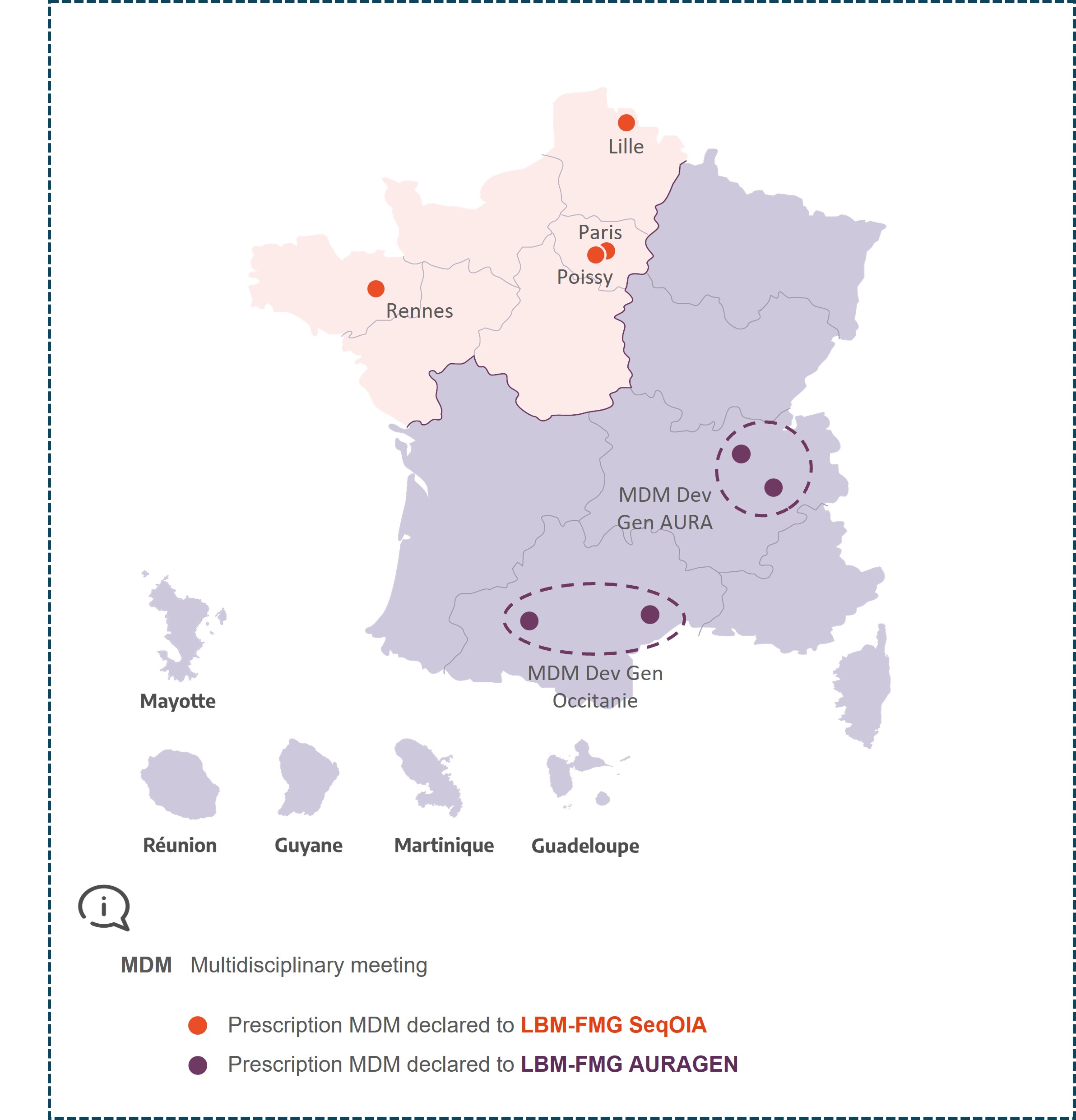
In the event of co-prescription of a panel of infertility genes by NGS (CFTR, ADGRG2) and testing for microdeletions of the Y chromosome, the diagnostic strategy to be carried out in the laboratory will be as follows, unless explicitly stated otherwise:
- In the case of normal hormone levels (FSH, LH, testosterone, inhibin B) and testicular volume (probable obstructive azoospermia), the infertility panel (CFTR, ADGRG2) will be performed as a first-line test. Then, if the result is negative, testing for Y chromosome microdeletions will be performed as a second-line test.
- If hormone testing (FSH, LH, testosterone, inhibin B) shows primary hypogonadism and reduced testicular volume (probable non-obstructive azoospermia), testing for Y chromosome microdeletions will be performed as a first-line investigation. Then, if the result is negative, the infertility panel (CFTR, ADGRG2) will be performed as a second-line test with an exploration of the genes contained in the 46,XY DSD panel (NR5A1, AR, etc., see ‘Diagnosis of 46,XY DSD’ in Biobook for the complete list of genes).
In the event of a negative result, a request for whole genome analysis using very high-throughput sequencing may be discussed in an upstream multidisciplinary team meeting as part of the France Genomic Medicine 2025 plan.
Clinical criteria: confirmed male infertility factor
- Phenotypic criteria:
- Testicular volume and azoospermia/sperm morphology abnormalities
- Exclusion of a known syndrome
- Testicular biopsy
- Age: reproductive age
- Other paraclinical tests: depending on the clinic (testicular ultrasound)
- Biological tests: hormonal assessment, seminal markers, etc.
- Testicular biopsy results
- Genetics depending on phenotype:
- Karyotype
- Y chromosome, CFTR, ADGRG2, AURKC, DPY19L2, SUN5
- Family history: collected during a genetic consultation
Genome Sequencing in diagnostic strategy
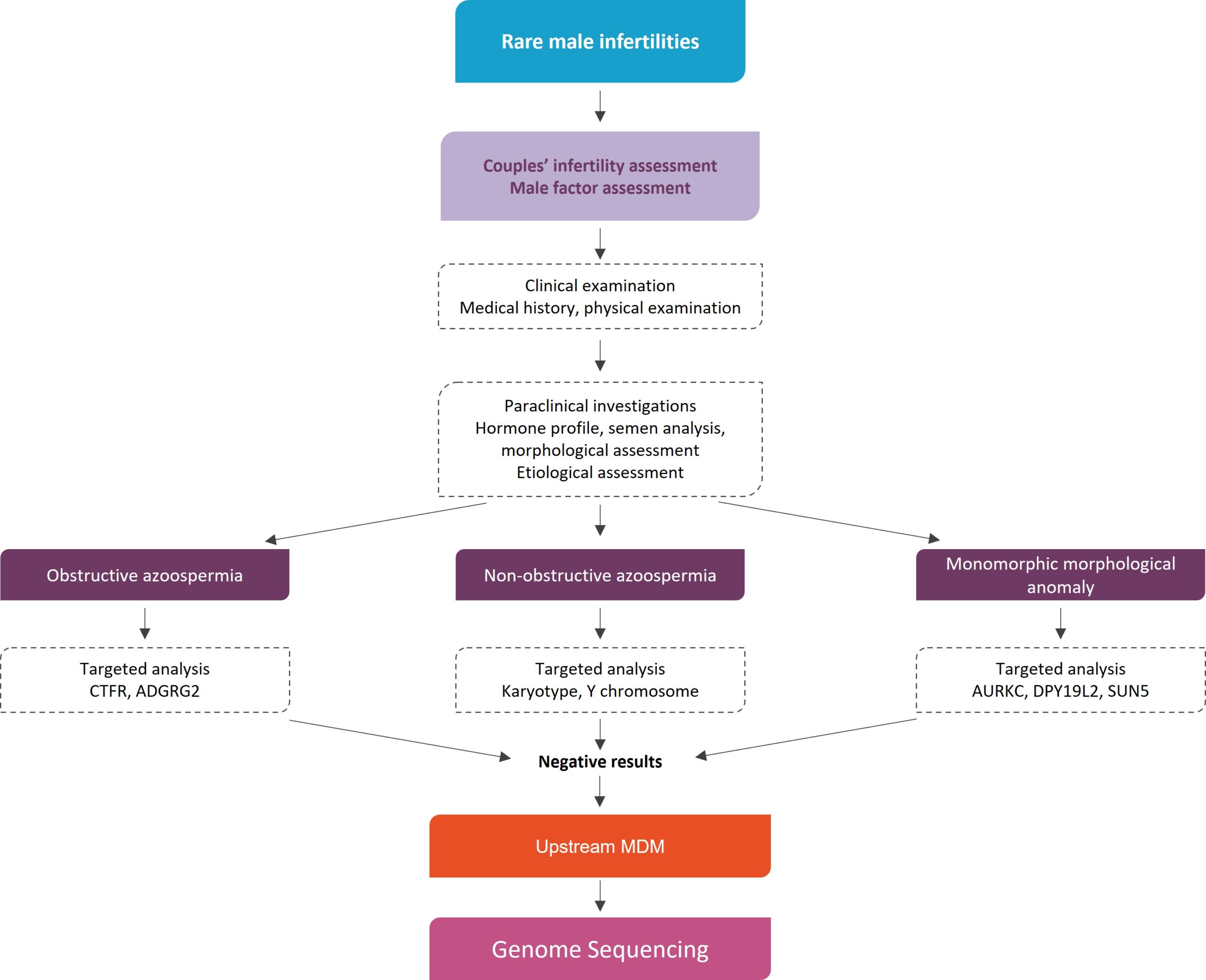
MDM cartography
MDM Rare male infertilites
MDM FIRENDO Dev Gen
Ingrid PLOTTON
Florence ROUCHER
Delphine MALLET
Jordan TEOLI
Pierre RAY
Charles COUTTON
Zine-Eddine KHERRAF
zine-eddine.kherraf@univ-grenoble-alpes.fr
Sylvianne HENNEBICQ
MDM FIRENDO Dev Gen
François VIALARD
Nelly SWIERKOWSKI
nelly.swierkowskiblanchard@ght-yvelinesnord.fr
Nicolas THIOUNN
Thierry BIENVENU
Jean-Michel DUPONT
Catherine PATRAT
MDM FIRENDO Dev Gen
Clara LEROY
Anne Laure BARBOTIN
annelaure.barbotin@chru-lille.fr
Francois MARCELLIarcelli
francois.marcelli@chru-lille.fr
Julie PRASIVORAVONG
julie.prasivoravong@chru-lille.fr
Geoffroy ROBIN
Adrien PAGIN
MDM FIRENDO Dev Gen
Eric HUYGHE
Francoise PARIS
Anne BERGOUGNOUX
Caroline RAYNAL
Eric BIET
MDM FIRENDO Dev Gen
Lucas FRETON
Celine PIMENTEL
Sylvie JAILLARD
Guilhem JOUVE