

Presentation
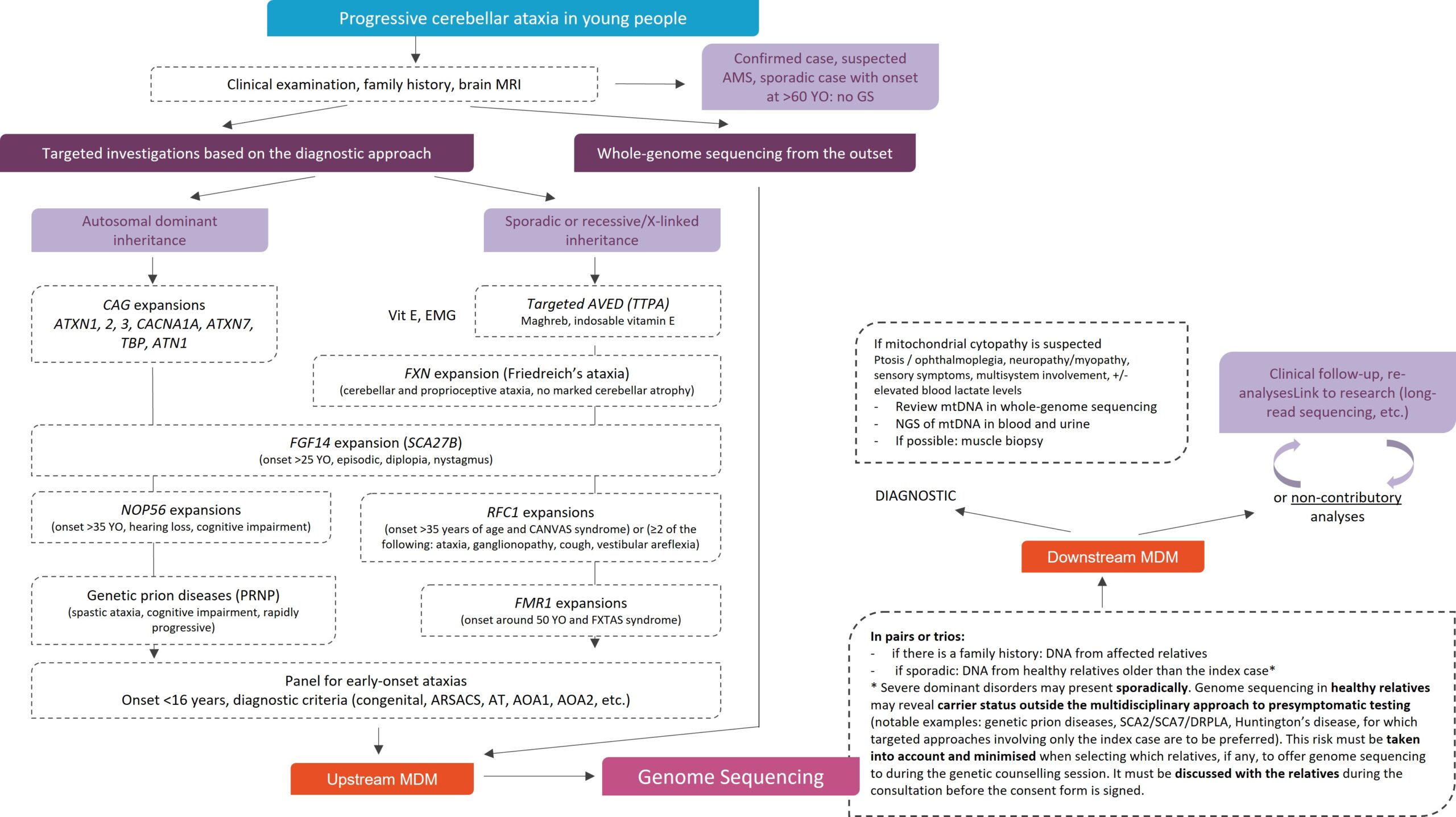
Hereditary cerebellar ataxias, characterized by a progressive cerebellar syndrome in children or adults, are linked in half of cases to pathogenic nucleotide expansions, with the remainder showing considerable genetic heterogeneity. When clinical features point toward a specific diagnosis, targeted or panel testing is recommended; otherwise, GS can be performed as a first-line approach.
Care should be taken to detect the possible presence of a dominant disorder with variable expression in healthy relatives, revealing carrier status outside the scope of presymptomatic testing. The interpretation of GS, which is constantly evolving, detects SNVs and most CNVs, and is gradually incorporating mitochondrial DNA expansions and variants.
Criteria before considering a discussion in MDM-FMG
Complete clinical examination, brain MRI with T2*/SWI and sagittal T1 sequences
No GS proposed if:
- Sporadic case AND age of onset > 60 years
- Doubt about a non-genetic cause, possible or probable cerebellar MSA phenotype
In cases of clear clinical indication (major ataxia gene, ataxia with biological or radiological biomarkers)
Targeted sequencing or a panel is recommended (see flowchart)
(!) In the presence of sporadic ataxia with a rapidly unfavourable progression, severe dominant pathologies should be considered, the presentation of which may be sporadic due to anticipation (e.g. SCA2, SCA7, DRPLA) or incomplete penetrance/variable expressivity (e.g. PRNP).
In the absence of clear clinical guidance, for a familial form regardless of age of onset, or for a sporadic case with onset <60 years of age
- GS is possible from the outset
- In pairs/trios (solo submissions should be avoided)
- Family history: collect DNA samples from affected relatives
- Sporadic cases : prioritize DNA samples from unaffected relatives older than the age at onset in the index case
Genome Sequencing in diagnostic strategy
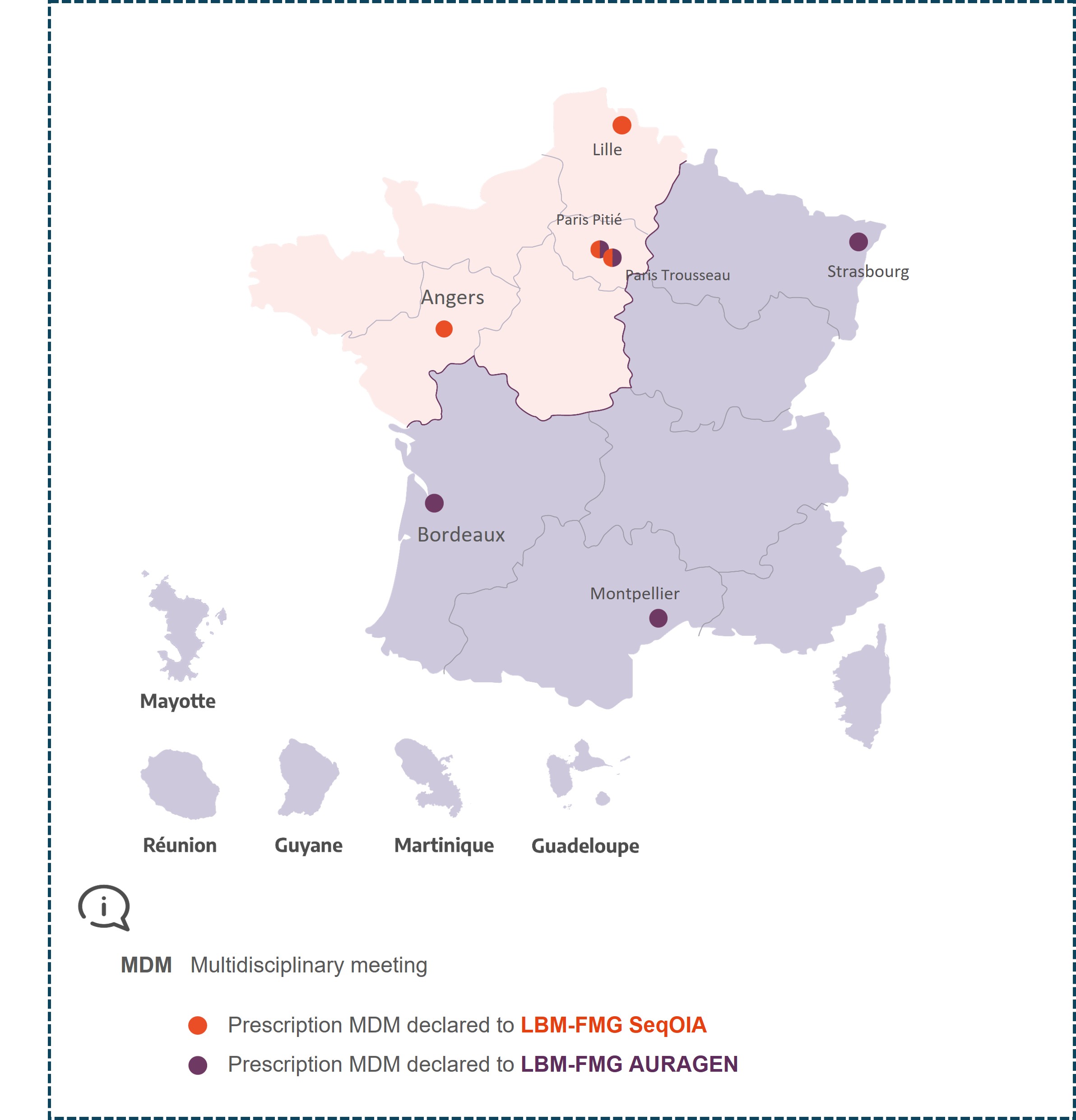
MDM cartography
MDM Neurogenetics Paris Pitié
Claire EWENCZYK
Alexandra DURR
alexandra.durr@icm-institute.org
Giulia COARELLI
Giulia.coarelli@icm-institute.org
Anna HEINZMANN
MDM Neurogenetics Paris Trousseau
Diana RODRIGUEZ
Florence RENALDO
Lydie BURGLEN
MDM Neurogenetics Angers
MDM Neurogenetics Bordeaux
Mathieu ANHEIM
mathieu.anheim@chru-strasbourg.fr
Christine TRANCHANT
christine.tranchant@chru-strasbourg.fr
Solène FRISMAND
s.frismand@chru-nancy.fr (Nancy)
Mathieu BEREAU
mbereau@chu-besancon.fr (Besançon)
Christel THAUVIN
christel.thauvin@chu-dijon.fr (Dijon)
Anne DOE DE MAINDREVILLE
adoedemaindreville@chu-reims.fr (Reims)
Quentin THOMAS
MDM Neurogenetics Montpellier
MDM Neurogenetics Lille