

Presentation
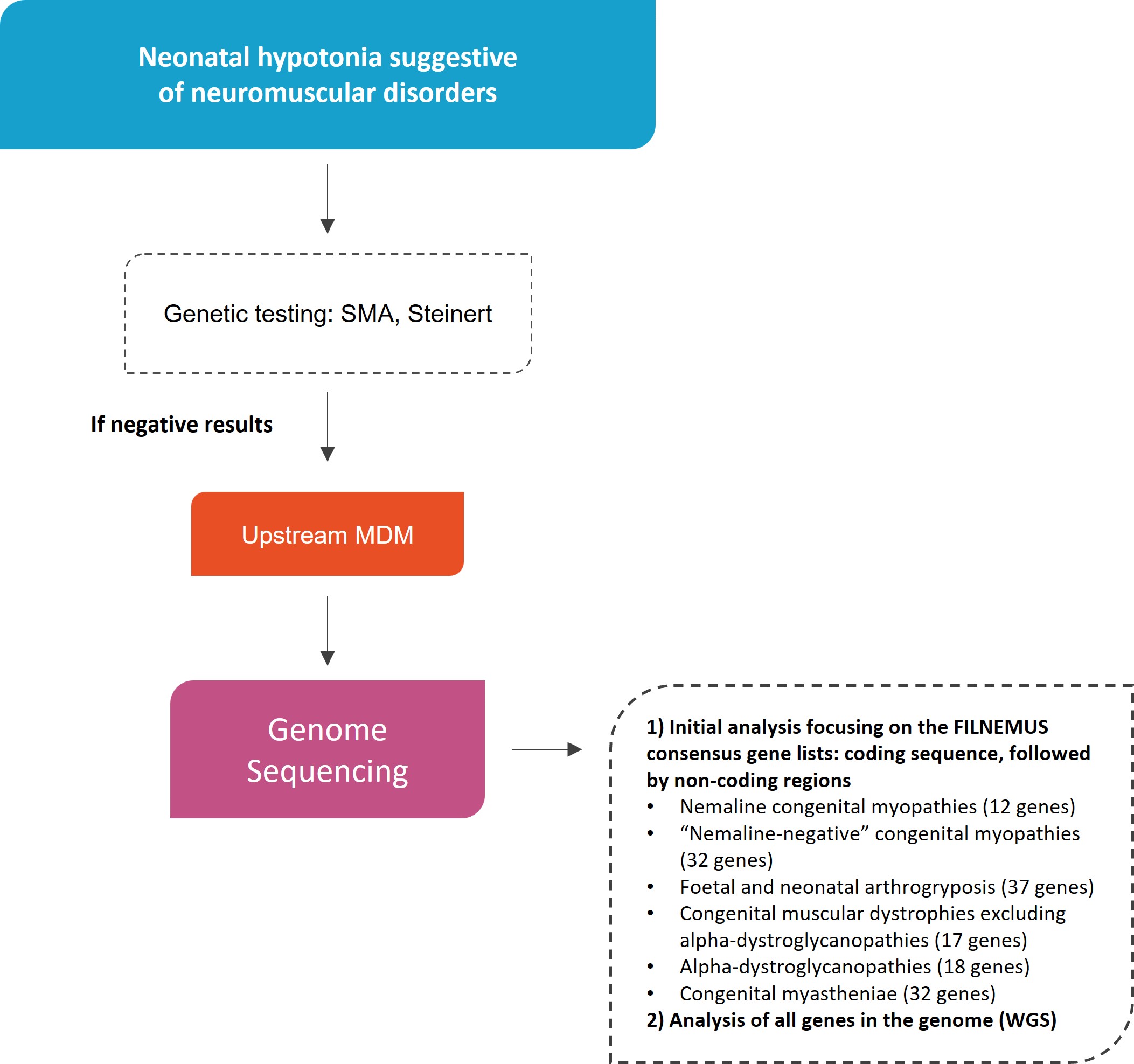
The indication concerns infants in their first year of life presenting with hypotonia, with or without respiratory distress, and suspected of having a neuromuscular disease, excluding Steinert’s myotonic dystrophy and infantile spinal muscular atrophy.
While the current targeted NGS strategy is effective, it requires joint or successive analysis on different panels.
We propose first-line analysis using “high-throughput sequencing” (HTS), as a replacement for panel-based testing
Criteria before considering a discussion in MDM-FMG
Child presenting with hypotonia that began in the neonatal period, axial and segmental, highly suggestive of a neuromuscular origin, with or without respiratory, nutritional, functional, orthopaedic, ophthalmological and neurocognitive repercussions.
The paucity of initial clinical signs requires first-line standardized paraclinical investigations, including a muscle pathology study, as well as quasi-systematic testing for infantile spinal amyotrophy and Steinert-type myotonic dystrophy.
If these investigations are negative, HTS is considered as a second-line approach and then possibly validated.
Genome Sequencing in diagnostic strategy
MDM cartography
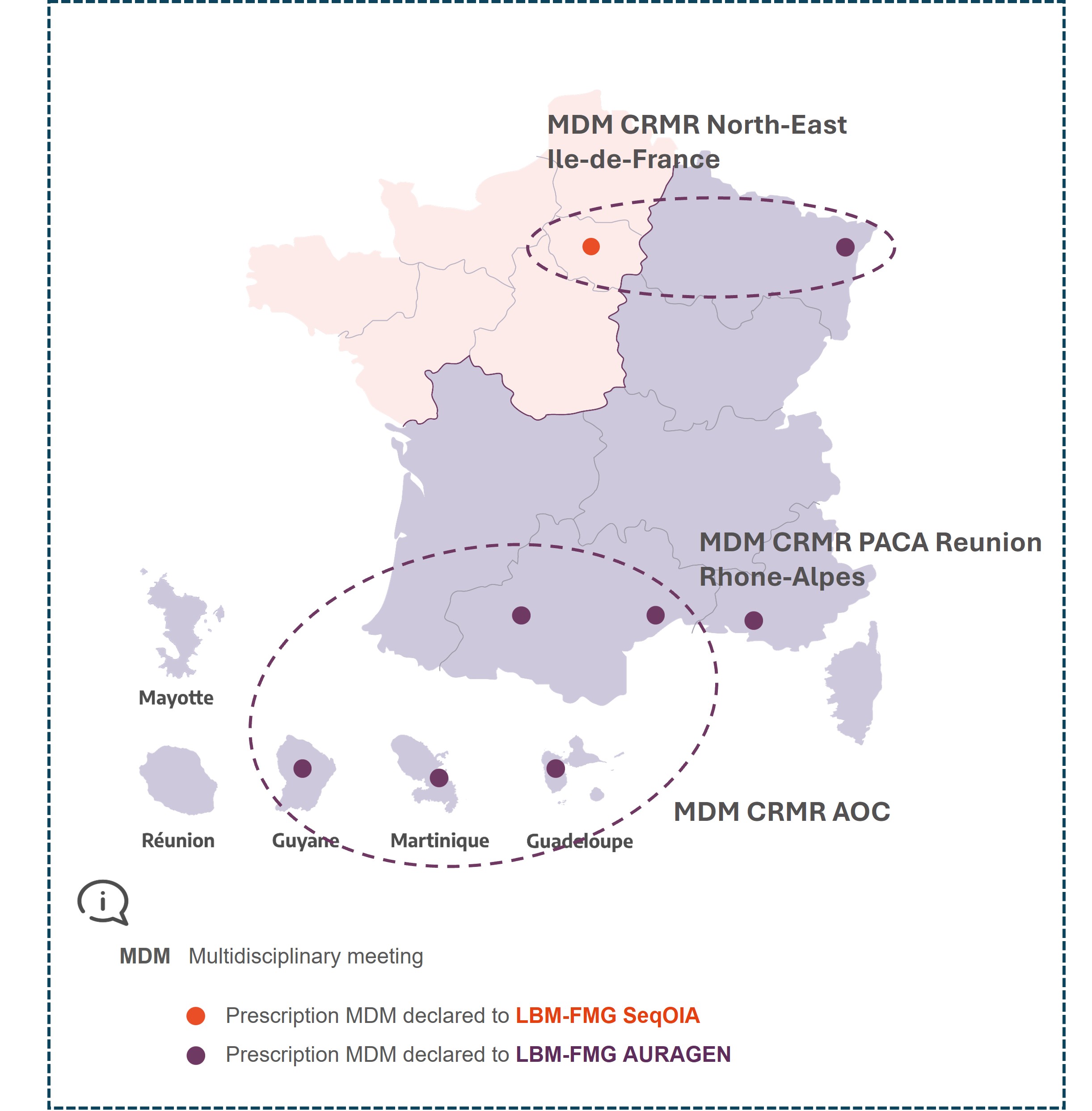
MDM CRMR PACA-REUNION-RHONE-ALPES
Referring clinician:
Klaus DIETERICH
Biologists:
Nathalie BONELLO
Martin KRAHN
Svetlana GOROKHOVA
svetlana.gorokhova@univ-amu.fr
John RENDU
Rita MENASSA
MDM CRMR North-East Ile-de-France
Referring clinicians:
Vincent LAUGEL
Vincent.LAUGEL@chru-strasbourg.fr
Cyril GITIAUX
Biologists:
Damien STERNBERG
Camille VEREBI
Juliette NECTOUX
Corinne METAY
Magalie LODIN-PASQUIER
MDM CRMR AOC
Referring clinicians:
Claude CANCÈS
Guilhem SOLE
Biologists:
Mireille COSSÉE